Tuesday, 3 November 2009

The Cut-Throat Battle for Halal Meat

Man Ist Was Man Isst” this German saying means “You are what you eat!”

Since the beginning of time, people in different cultures have tried to make laws about what to eat, what not to eat and how to eat what. 

The concepts of Kosher and Halal are codes to followers of Judaism and Islam about what food products are good and which are bad for them. The market for Halal food for Muslims in the West is a multibillion dollar industry with cut-throat competition.


Meat for Muslims in the West is a Huge Market

One out of every six persons alive today is a Muslim. Of the 1,5 billion followers of Islam worldwide, a significant proportion live in the West. According to the 2001 census 2.7 % of the UK population of 61 million are Muslims. Estimates of Muslims in the USA vary from 1.1 million (American Religious Identification Survey) to 6-7 million (Council on American-Islamic Relations).

Photo source:

American Muslims are one of the most racially diverse religious groups in the United States according to a 2009 Gallup poll. As other Muslims in the West, they may disagree about many things, but one thing they agree upon is that their meat is properly slaughtered or Halal and not Haram or improper.

What is Halal?

The animal is to be slaughtered (only by a Muslim) should be healthy and alive at the time. 

Here is a video of a properly done Halal slaughter. Warning: Gruesome and shocking to watch!


Since carrion or eating dead animals is forbidden, the jugular vein, carotid artery and windpipe are severed with a razor sharp knife by a single swipe, to cause minimal pain. Further, all the blood should naturally drain away and the meat kept away from Haram meat like pork.


One county in Ohio, USA has a 2005 law against selling or producing food mislabeled “Halal”, which does not meet Islamic dietary standards. Halal Monitoring Committee in the UK tries to provide comprehensive certification.

The Australian government regulates all Halal slaughter, but in France there are as many certification bodies as France has varieties of cheese. Halal Industry Development Corporation, based in Malaysia has tried to create a global Halal certification standard but not succeeded.

The Lucrative market for Muslim food dollars in the West


The market for Muslim food in the West is about $650 billion globally. Big European chains have been quick on the pursuit of this catch. The French Carrefour, the second largest retailer in the world, the British chain Sainsbury sells Halal meat and they even sell Halal chocolate at Tesco.

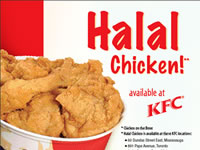
Zabihah, lists an online guide to shops and restaurants, which sell Halal products globally. Even Fast-food chains like KFC have Halal only restaurants in the UK and France.
No country has any kind of ban on foodstuffs favoured by Muslims though there may be bans on apparel. France forbade Muslims students to wear headscarves in schools in 2004. There is no similar ban in the UK. 69% of non-Muslim respondents in the USA, would allow Muslim students to wear headscarves and 64% would allow Muslims to date their sons or daughters, according to a July 2007 Newsweek survey.

Muslims may be disproportionately poor in the West, but they spend proportionately larger sums on food than other population groups. Maybe for this reason as well as for the rich cuisine, Muslim food has also become popular in the West. Antoine Bonnel, of Paris Halal Expo, claims that non-Muslims spend 12-14% of their income on food but Muslims spend double that amount on food and meat makes 30% of their food budget.

Why Oppose Halal?

Are there any reasons for opposing the practice of halal and kosher?


  • Animal rights groups, even if they might eat meat themselves, object to the Halal method of slaughter as the animal should be alive when the throat is slit and the animal does feel pain.
  • Immediately after coming to power, the Nazis outlawed Jewish ritual slaughter (very similar to Halal). Mussolini followed suit. As the Allies liberated Europe, these bans were revoked except in Iceland, Norway, Sweden and Switzerland.
  • Some countries like New Zealand insist on specific methods of stunning before ritual slaughter as a compromise.

Some people strongly express their opinion that vegetarianism and Islam don't go very well hand in hand. But, this is not a comprehensive opinion shared by all Muslims. There are many Muslims who live perfectly sane, happy and healthy lives while choosing not to eat meat. 

I asked a Muslim friend of mine about his family's vegetarianism, and he replied "The one overall guideline on food that the Prophet gave was: Eat of what is halâl and what is agreeable to you. That says it all."


Saturday, 17 October 2009

100 Years Ago – What Was Happening in 1909?

What kind of a place was the world 100 years ago, in 1909? 
It was surely very different from our familiar world of today.
  • Capital punishment was regular practice in almost 99% of human societies.
  • Cannibalism was practised in Melanesia and the Pacific Islands.
  • 90% of doctors in the USA had no college education
  • Syphilis, which drove people crazy and killed them, was still incurable.
  • The tallest structure in the world was the Eiffel Tower.
Photo source:

A selection of “snapshots” from around the world shows that many things have remained surprisingly unchanged from 100 years ago.

Belgium
Massive genocide in Africa ends as King Leopold II dies. 


Photo source:
  • The Encyclopædia Britannica estimates that between 8 and 30 million people die in Belgian Congo through his private colonialism. 
  • Auguste Marie François Beernaert gets the Nobel peace prize for contributing to the Permanent Court of Arbitration at The Hague.
Canada
Canada was creating the Immigration Act, 1910, which made everyone except British subjects domiciled in Canada needing permission to land in Canada.


Photo source:

China
  • Famine in Anhui province kills about 4 million.
  • Confucius is raised to the same rank as Heaven and Earth, which are worshipped by the Emperor alone.

Cuba
US troops finally leave Cuba, 11 years after the Spanish American war finished.
England
  • The first World Vegetarian Congress founded in Manchester.
  • The Secret Service Bureau, the first incarnation of MI5, was established in 1909 to combat Imperial Germany's espionage operations in the United Kingdom.
  • Britain starts arms race in response to Germany’s plans to build four Dreadnought battleships.
  • Construction of the world’s then largest passenger ship RMS Titanic begins in Belfast.
  • Joan of Arc is beatified, 4 years after the 1905 French law on the Separation of the Churches and State.
  • Louis Blériot is the first man to fly across the English Channel.


Germany

Paul Ehrlich discovers Salvarsan as a treatment for Syphilis, which was called: 

  • the French disease in Italy and Germany, 
  • Italian disease in France 
  • Spanish disease by the Dutch 
  • Christian disease by the Turks 
  • British disease by the Tahitians
War is one of the elements of order in the world established by God. The noblest virtues of men are developed therein. Without war the world would degenerate and disappear in a morass of materialism” says General Count Kuno von Moltke, a friend of Kaiser Wilhelm II. He is soon implicated in the Eulenberg homosexual scandal and beaten up by his wife Lilly.

India
Indians could be elected to legislative councils for the first time by virtue of the Indian Councils Act of 1909, commonly known as the Morley-Minto Reforms.
Italy
Gugliemo Marconi gets the Nobel Prize for discovering wireless telegraphy (radio).

Japan
  • Vaccination is compulsory in Japan.
  • Census reveals that 5,6 persons live in each Japanese household and 11% live in cities.
  • Prince Hirobumi Ito, former Prime Minister, the first resident-general of Korea, who opposed annexation, is assasinated by independence activist Ahn Jung-Geun and Korea is annexed by the Japanese Empire.

Ottoman Empire
30 000 Armenian Christians slaughtered in the Adana Massacre.
Russia
  • Okhrana General Gerasimov reports to Czar Nikolai II that not a single revolutionary organization is still functioning in the Russian Empire. 
  • A bloody Bolshevik train robbery at Miass in the Urals nets 60,000 rubles and 24 kilograms of gold.
  • Pyotr Stolypin, Prime Minister of Russia begins a campaign of repression of national minorities.
Selma Lagerlöf wins Nobel Prize for literature. During WWII, she sends her gold medal and the gold medal from the Swedish Academy to the Government of Finland to help in the war with Soviet Union. The government of Finland is touched, raises money by other means and returns the medals to her with gratitude.


Photo source:

USA


  • The USA has its heaviest (136 kgs) white Republican president (William Howard Taft). His pursuit of world peace through his self-founded League to Enforce Peace and “Dollar diplomacy” was a disaster for him.
  • Plastic, then called Bakelite, is invented from phenol and formaldehyde by Leo Hendrik Baekeland.
  • National Association for the Advancement of Colored People founded to end segregation and oppose lynching
  • 95% of American babies were born at home.
  • 90% of doctors in the USA had no college education as doctors went to medical school (many were attacked in the press as sub-standard). In Texas, a doctor coming to town only had to say he was a doctor, register with the health officer and start practising.
  • Most American women only washed their hair about once a month using borax or egg yolks.
  • Marijuana, heroin, and morphine were all available over the counter at the local corner drugstores. "Heroin clears the complexion, gives buoyancy to the mind, regulates the stomach and bowels, and is, in fact, a perfect guardian of health." - They advertised then.
  • First woman drives motorcar across the USA. Alice Huyler Ramsey from Hackensack, New Jersey, with 3 non-driving companions drives 3800 miles from Manhattan to San Francisco in 59 days.

Monday, 28 September 2009

Who is a Real Arab!

I don’t understand your Arab culture.” 
is the phrase I overheard at a cafe as two men wearing Western clothes were discussing very animatedly in good cheer and laughing together occasionally. Then, so typically among good friends, they had the traditional argument about ’Let me pay the bill, I insist’. This set me thinking – who is an Arab?


The stereotypical perception of an Arab in many countries is that an Arab is a Muslim, lives in the Middle East and is probably loaded with oil money. Unfortunately, another totally mistaken stereotype has started to become prevalent – the Arab terrorist. All these stereotypes are totally wrong.

What is the Definition of an Arab?

In Arab schoolbooks, the Arab world ranges from the Persian Gulf to the Atlantic Ocean and from Syria to Sudan in Africa. 

  • It was only in the 19th and 20th century that Arab nationalism created this concept of an Arab world. 

Before that, people usually identified themselves with tribes or with political structures like the Ottoman Empire. Pre-Islamic Arabic as a language dates back to the 4th century.

There are three methods of classifying as an Arab.
  1. Linguistic – If your first language is Arabic as for about 200 million people.
  2. Geneological – If you can trace your ancestry to the original inhabitants of the Arabian Peninsula.
  3. Political - The League of Arab States or Jāmiʻat ad-Duwal al-ʻArabiyya has 339 million people living in 22 states. They define an Arab as “A person whose language is Arabic, who lives in an Arabic speaking country, who is the citizen of an Arab country, whose father is an Arab, and who is in sympathy with the aspirations of the Arabic speaking peoples.”


How the Arabs See Themselves

Only 32% of the 4100 people surveyed in six Arab countries by Professor Shibley Telhami’s group at the University of Maryland saw themselves as Muslims or Arabs. 35% considered themselves primarily as citizens of their own country. Only 1% had the idea of being a world citizen.


Source:

Compare the situation to 2010.

Not all Muslims are Arabs. Arabs are only 24% of the 1,4 billion Muslims in the world. 85% of the population in Morocco and 55% in Algeria are Berbers (Famous Berbers: Zinedine Zidane, Saint Augustine, Emperor Septimius Severus) who are non-Arabs.

Most of the people living in Egypt do not consider themselves Arabs.

  • In Sudan, there are more than fifty ethnic groups and only half the population can speak Arabic.


Is Arab 'Identity' a matter of Language, Religion or Ethnicity?


Photo source:


This is a very complicated question and there are many opinions when one considers that there are so many different nation states, religious sub-divisions and ethnic variety among the 'Arabs'.

Does language and history define national identity for the Arabs more than religion?
  • There are many serious scholars, like Abu Khaldun Sati al Husari (1881-1967) the Syrian/Ottoman theoretician of Arab nationalism and author of A Day in Maysalun, who believes that language and not religion, economy and geography are important for the formation of nationalism. Language is "the heart and spirit of the nation," and history is its "memory and feeling." 
  • The British-Lebanese historian Albert Hourani in his book, Arabic Thought in the Liberal Age, agrees by claiming that Arabs are "more conscious of their language than any people in the world." 

The contrary view, that religion does play a major role, also has qualified support.
  • Abd al-Aziz Duri, the eminent Iraqi social historian says "Islam unified Arabs and provided them with a message, an ideological framework, and a state." He goes on to clarify the link between Islam and Arabism as being "were closely linked at first, but subsequently followed separate courses."

Are Arabs Antagonistic to Western Civilization?

Many people assume that Arab civilisation is eternally antagonistic to Western civilisation. The ridiculous stereotype of the Arab terrorist in the West and the equally mistaken notion of America as the ‘Great Satan’ among the Arabs do betray a history of armed conflict. From the Battle of Tours in 732 CE through the Crusades onwards there has been no love lost between the civilisations. 

Ironically, Islam has very much in common with the Judaic and Christian traditions in the form of common religious figures, customs and traditions. They are all children of Adam, Moses and Abraham. 
  • Arabs were very instrumental in transmitting scientific knowledge from the Orient to the Occident in centuries past.
  • It was the Arabs who brought the numerals and the zero. 
  • Many words in the English and Spanish languages are from the Arabic. Most people drinking alcohol wouldn’t care to know that it is an Arabic word. 
On the other hand, a significant portion of the educated people in the Arab world dress in Western costumes, are proud to speak fluent English and educate their children in Western universities.


How People Living in Arab Countries Use the Internet

The use of the Internet has started changing Arab societies politically, socially and economically as it has done in many other countries. 

It is perhaps to hasty to draw conclusions if frequency of Internet use has any positive correlation to political freedom and dissent threshold in these countries. But frequency of Internet use most certainly has a large impact on all aspects of life for people living in these countries, unless they are immune to commercial and other forms of propaganda. 


Things have changed a lot in Arab countries. In the days of Saddam Hussein, people who could afford getting Internet connection (frightfully expensive in those days) also needed to sign the following declaration.

  • The subscription applicant must report any hostile website seen on the internet, even if it was seen by chance. The applicants must not copy or print any literature or photos that go against state policy or relate to the regime. Special inspectors teams must be allowed to search the applicant’s place of residence to examine any files saved on the applicant’s personal computer.

Currently Saudi Arabia follows a very strict approach. Every single cybercafe must install hidden cameras and record the names and contact information of each customer. Actually, this is not that uncommon around the world, even in a country like Italy.

OpenNetInitiative (ONI) reports that Saudi Arabia's 'filtering' centres on the following:
  • pornography 86%
  • gambling 93%
  • religious conversion 41%
  • sites which provide tools and methods to circumvent filters 41%
What Saudi Arabia seems to care less about are
  • Israel 2%
  • religion 1%
  • alcohol 1%
  • politics 3%
  • gay and lesbian issues 11%
Wonder why the Saudi high concern with pornography is not visible in the gay and lesbian arena (86% -vs- 11%)? 
  • Is it because they think that such matters are harmless and let them do it or
  • They do it in any case so why bother or
  • The incidence of gay sexual behaviour (but not identity) is so common that there is no point in making a noise
  • What could men do with men and women do with women? - Is there a trace of Queen Victoria's supposed attitude that "Women do not do such things!" (actually it is a myth, she never said it)


Suggestions for further reading: