Showing posts with label evolution. Show all posts

Saturday, 15 November 2008

Can we Navigate by Cows rather than by using Magnetic Compass or GPS?

How can we navigate by using the positions of cows?


Photo source:

Cows behave as magnetic compass needles as they align their bodies in a north-south direction.

Cows have been valued and considered sacred in most human cultures as long as humans have been around.Cows have been valued and considered sacred in most human cultures as long as humans have been around.

Photo source: Wikipedia Commons

  • In the Eddas, the myth of Iceland written between the 8th and 13th centuries, Audhumla ("Without Impurity") created humankind by licking the salt and hoar frost on ice blocks in three days. 
  • In Hinduism, the cow is considered the mother of gods. Kamadhenu, the sacred cow in ancient India, is the cow, which grants all wishes and desires. 
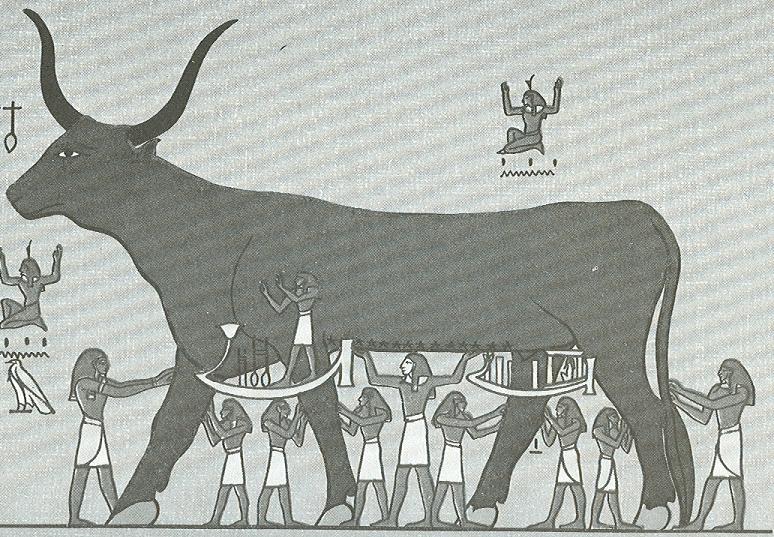
  • In ancient Egypt, there were many cow deities like Hathor, the Milky way, Nut, the sky goddess, Mehueret, the Flood and Bata, the goddess of fertility. 
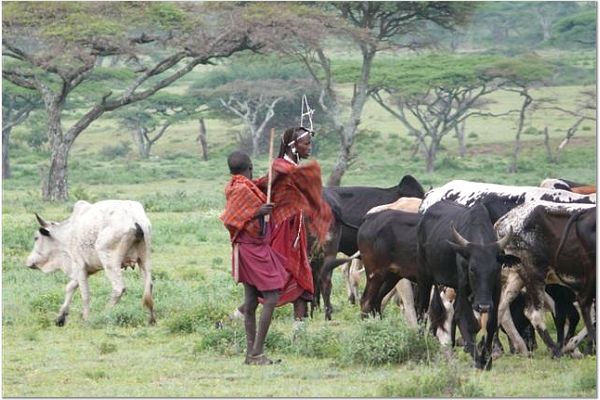
  • The Maasai people in east Africa claim that all cattle in the world belong to them. With an average of 14-19 head of cattle per person, the Maasai are one of the wealthiest cattle-owning peoples in Africa. "I hope your cattle are well", the Maasai greet each other.

Animals Considered as Machines by Science, Paradoxically

Even Charles Darwin, the father of evolution theory considered animal intelligence to be a worthy field of study. He found that even earthworms are cognitive beings, as they need to make judgments about the kinds of leafy matter they use to block their tunnels. 


Photo source:

In the early 20th century, behaviourism regarded animals as machines and considered all field observations of animal cognition as anecdotes tinged with anthropomorphism. Since then, animals are not considered by scientists to have cognitive functions, which most pet owners totally disagree with.

Recently, serious researchers like Sabine Begall, Jaroslav Červen, Julia Neef, Oldřich Vojtěch, and Hynek Burda of the University of Duisburg-Essen in Germany researched animal magnetism. In a paper published in the Proceedings of the National Academy of Sciences, they studied if large animals like cattle display the ability to perceive magnetic fields.

By studying thousands of images of grazing cows captured by Google Earth, and compensating for the fact that grazing animals orient themselves to minimize wind chill and maximize the warmth of the sun, they found that cows do have a tendency to act like compass needles.

Can we look at cows and tell where the magnetic north is?

Photo source:

Please continue using your compass or GPS. The study does, however, open new horizons for studying how magnetoreception affects animals in fields like applied ethology, which is animal husbandry, and animal welfare. The researchers also claim that birds and mole rats have magnetic particles of magnetite in their cornea.

The human eye and the brain also generate magnetic fields. Researchers R.A. Armstrong and B. Janday of the Biomagnetism Research Group, Department of Vision Sciences, Aston University, Aston Triangle, Birmingham have found that both the eye and the brain, when stimulated with some visual cues generate magnetic fields. These magnetic fields can then be measured with a magnetometer; a device which uses superconducting technology.


Photo source:
As the saying goes "All is not butter that comes from the cow" - Proverb.

Anti Cow Sentiments


Well, not everyone is cow-friendly. Some famous people have been very anti-cow.
  • "A mind of the caliber of mine cannot derive its nutriment from cows." George Bernard Shaw
  • "Sacred cows make the best hamburgers." Mark Twain
  • "Who was the first guy that look at a cow and said, "I think that I'll drink whatever comes out of those things when I squeeze them?" Bill Watterson
  • "The cow is nothing but a machine which makes grass fit for us people to eat." John McNulty


Sunday, 24 August 2008

Not Only Humans But Animals, Even Bacteria are Altruistic

There is not a single human society, past or present, where altruism of some kind is not considered a superior characteristic. 


Altruistic behaviour is seen to arise out of soulful maturity. Sacrificing oneself for the greater good of many is the ultimate act of self-negation and the true mark of a hero.

What is the Definition of Altruism in Everyday Language?
Regard for others, both natural and moral; devotion to the interests of others; brotherly kindness; -- opposed to egoism or selfishness. 
Altruism is a divine quality that is considered to distinguish the noble from the base. We humans always like to think that we are the pinnacle of development, created in the image of divinity but is it always so simple?


Photo source: 
When we are ashamed of some kind of behaviour, we label that behaviour as animal. Rather conveniently we forget that we as humans are indeed biped primates belonging to the 
  • Family Hominidae
  • Order Primates
  • Class Mammalia
  • Phylum Chordata
  • and Kingdom Animalia
Of course, we never ask other animals what they think of us humans on this issue of superiority, especially the fact that there is no record of any animal acting stupidly out of deliberate choice as many humans do repeatedly.

Would animals laugh if we told them that only the higher primates of the family Hominidae could practice altruism? Yes they would. Altruism is not uncommon in the animal world. Even the lowly bacteria consistently exhibit altruism.


Definition of Altruism in Evolutionary Biology


The definition of altruism in evolutionary biology is, however, slightly different. In evolutionary biology, an organism is said to behave altruistically when its behaviour benefits other organisms, at a cost to the organism itself. These costs and benefits to the organism are measured in terms of reproductive fitness, or expected number of offspring. 

Thus, by behaving altruistically, an organism reduces the number of offspring it is likely to produce, but boosts the number other organisms are likely to produce. This is a clear trade-off, which improves the well-being of the group. 


Altruism in Salmonella Bacteria and Animals

Salmonella bacteria sacrifice themselves for the greater good. As they enter the digestive tract, it’s a hostile world as other bacteria have dug themselves into good strategic positions. So the salmonella ‘select’ one in six microbes during cell division as an advance group. As they dig into the intestinal tissues, they cause the human defence system to inundate the tract. This clears away all the other bacteria, when colonization by other salmonella can begin. To paraphrase the great Winston Churchill, “Never in the field of intestinal conflict was so much owed by so many to so few.”

Huani feeds the tiger triplets and her own puppy at the Paomaling Zoo in Jinan, China. Photograph: Lu Chuanquan/Xinhua/AP
Dolphins regularly support sick or injured animals by swimming under them and pushing them to surface so that they can breathe. One extreme example of altruism is the Stegodyphus spider, which has a unique system of matriphagy, when the offspring actually eats the mother. Felix Warneken and colleagues from the Max Planck Institute for Evolutionary Anthropology present experimental evidence that Chimpanzees often help other species, even humans without any reward.


Neanderthal Man Became Extinct Due to a Lack of Altruistic Behaviour

James Shreeve, in his book The Neanderthal Enigma: Solving the Mystery of Modern Human Origins. New York: William Morrow & Co, 1995, presents his theory of why the Neanderthal man became extinct. 
Shreeve says that Neanderthal man was an exaggerated case of Me, Myself and I. In time, Neanderthal man became extinct because of an inability to produce altruistic and cooperative behaviour towards other Neanderthals, especially the females and children of their own clans. 

The ability to share experience, artefacts and values with others created culture in the weaker Cro-Magnon man helped them survive and evolve.

Criticism of Altruism

Critics of altruism in nature (e.g. Trivers 1971) say that it is only delayed self-gratification as we are altruistic in the expectation of future returns of favours. 


Photo source:

Even when it is disadvantageous to us and entails sacrifices, it is ultimately genic self-interest, they say. 

What People Say About Altruism


Altruism is a vision of a higher call for some:
Every man must decide whether he will walk in the light of creative altruism or in the darkness of destructive selfishness. - Martin Luther King, Jr. 
Others are pragmatic and want to have the cake and eat it too. 
I would rather be kept alive in the efficient if cold altruism of a large hospital than expire in a gush of warm sympathy in a small one. - Aneurin Bevan 
Then there are hardliners: 
If any civilization is to survive, it is the morality of altruism that men have to reject. - Ayn Rand
And realists: 
Let us try to teach generosity and altruism, because we are born selfish. - Richard Dawkins 
Reference:
  • Dawkins, R., 1976, The Selfish Gene, Oxford: Oxford University Press
  • Fletcher, J. A. and Doebeli, M., 2006, ‘How Altruism Evolves: Assortment and Synergy’, Journal of Evolutionary Biology, 19: 1389-1393
  • Hammerstein, P., 2003, ‘Why is Reciprocity so Rare in Social Animals? A Protestant Appeal’, in P. Hammerstein (ed.) Genetic and Cultural Evolution of Cooperation, Cambridge MA: MIT Press.
  • Trivers, R.L., 1971. ‘The Evolution of Reciprocal Altruism’, Quarterly Review of Biology, 46: 35-57