Sunday, 17 February 2013

Why Should Long Dead Kings like Richard III be Rehabilitated?


History if always written by the victors and those who are defeated (usually in battles) are vilified and depicted for posterity as embodiments of all the qualities, which should be loathed. 

This seems to be a general rule ranging from Egyptian Pharaohs of the old kingdom (3rd millennium BC) to the Republican and Democrat presidents who take turns occupying the White House in Washington, USA even in our iHistory age.


Occasionally, by a twist of fortune, some hapless ruler, much maligned by the derisive and venomous propaganda of their successors are indeed rehabilitated. 

The latest one with such luck is Richard III, the last English king of the House of York (1483-1485). Shakespeare portrayed Richard III as an ugly hunchback, “rudely stamp’d”, “deformed, unfinish’d” and who cannot “strut before a wanton ambling nymph”. It is so easy to imagine Richard III, like Gollum in the Lord of the Rings contorted in self-loathing and hissing out "I am determined to prove a villain / And hate the idle pleasures of these days." It is also Shakespeare’s genius, which has made Richard III utter some memorable quotes like:
  •  “Now is the winter of our discontent" (a phrase later used to refer to James Callahan’s 1978-1979 prime ministership in England)
  • "A horse, a horse, my kingdom for a horse!"

The Crimes of King Richard III

  • Coming to power by employing questionable means (having Edward IV’s marriage declared invalid as he was still legally married thus making Edward V illegitimate and thus not eligible to become a king)
  • Getting rid of two young princes by having them murdered
  • Beheading people like the Duke of Buckingham who rebelled against him

All these were pretty standard stuff in those days, anywhere in the world except rather often among some tribes for whom we contemptuously use names like aboriginals or primitives.

Coming to power by questionable means – Well, that’s pretty common in ‘civilized’ democracies also today. Countless voters then lying in their graves secured the election of John F. Kennedy in 1960, George Bush Jr. also came to power using ‘questionable means’ not to talk of Silvio Berlusconi.

Getting rid of people who challenge our ideologies and ‘way of life’ – nowadays we use names like war on terror, ethnic conflict, regime change or finding weapons of mass destruction to justify similar actions.


Politicians turning things upside down to serve regime interests as in the case of Anna Politkovskaya is also pretty common nowadays.

Achievements of King Richard III

They are rather impressive, especially considering his short reign of 2 years 1483-1485. In fact, some of his ideas were centuries ahead of their times.

  • Council of the North did begin to improve conditions for Northern England as before that most economic activity centred on the capital alone. 
  • Court of requests, an institution that enabled poor people who could not afford the expensive lawyers in the formal courts could have their cases heard officially (Kleineke, 2007)
  • Judicial bail system, to secure the rights of the accused and protect them from imprisonment before trial and not have their property seized. 
  • Rescinded the ban of printing and selling books.
  • Ordered the translation of the written laws into English from traditional French. 

Compare fairly and without bias the achievements of Richard III to 10 years of Tony Blair’s (1997-2007) or 8 years of George Bush Jr.’s (2001-2009) ‘reign’ and their ‘body count’ and both of them may have to hang their heads in shame sitting in jail. You may like to place your bets on the likelihood, but that is most unlikely to happen even in 2014!


Rehabilitation of Rulers Maligned by Subsequent History

The recent rehabilitation of the last Plantagenet king of England, Richard III after his remains were discovered under a car park in Leicester, UK may start a boom of making maligned ‘villains’ appear transformed as heroes from under the veils of infamy. Now there is a campaign in Scotland to rehabilitate the blood-tarnished image of the 11th century king Macbeth.


Cleopatra VII, who ruled Egypt for 21 years, lost her kingdom, regained it, lost it again and was good at ruling an empire has been painted as a wanton and lusty temptress. That she probably was, but she was infinitely more. Speaking nine languages, having great political acumen and charm, she seems to have been totally devoted to her country. This would be a not so common trait among contemporary politicians. Is it time to rehabilitate Cleopatra?


Stalin, the big daddy of baddies, with a killing toll of about 20 million (Robert Conquest: The Great Terror, 2007) is fast being rehabilitated in certain quarters. Though other may not like it, neo-Stalinism is here to stay. Neo-Stalinism is, according to Frederick Copleston, S. J., 
"..not exclusively an expression of a desire to control, dominate, repress and dragoon; it is also the expression of a desire that Russia, while making use of western science and technology, should avoid contamination by western 'degenerate' attitudes and pursue her own path."
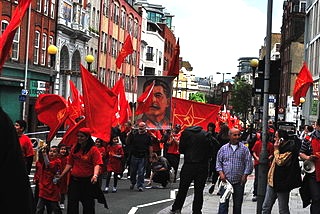
Mao Zedong, the burly moonfaced demigod of China has been re-elevated to his demi-god status in modern China. Anyone who even went near him and can dictate, write or afford ghostwriters has written eulogies like his last concubine (Zhang Yufeng) and his bodyguard (Li Yinqiao) did.


Pol Pot, a heavyweight baddie, who killed 1-3 million people (out of a population of 8.4 million), is fairly advanced on the way to rehabilitation. Wasn’t it so that the British and Americans voted in the UN to legitimise the defeated regime of Pol Pot (Pilger, 2005)?


When is the biggest of the baddies, a certain Austrian postcard painter, who killed 30-50 million people, although using other methods than badly painted postcards, going to be rehabilitated? Or is he going to perpetually anchored in a repository of history's worst baddies along with Nero, Chengiz Khan etc.


Small disclaimer here: This last item was just out of academic interest. I am not even remotely interested in Austrian postcard painters and their politics.


Adolf Hitler is actually getting rather popular in India, for very different reasons though. The brand just arouses people and they buy. Anti-semitism or the hate messages of his don't have any place there, but he is seen as a cool and tough guy who can make trains run on time, a kind of Marlboro man among leaders. Of course the fact that he opposed and fought Britain, and this hastened Indian independence is also an argument though very few Indians nowadays even think of this aspect.

Photo source:

Should History be Rewritten?

The commercial angle and the attraction of theme parks á la Osama Bin Laden in Abbotabad as has been suggested by DavidMitchell of the Observer is one approach, good for the local economy.

Seriously speaking, yes, history should be continuously re-examined and re-evaluated in the light of new findings. Consider, for example the debunking of the Aryan Invasion Theory (Metspalu, 2011). 

This debunking of the Aryan invasion theory allows us:
  • To see matters in an entirely different perspective without the burdens of racial and ethnic propaganda
  • We can appreciate the achievements of other peoples and nations
  • The agendas of hate or maligning others may give way to genuine appreciation and universal brotherhood.


Sources:
  • Tell Me No Lies: Investigative Journalism and its Triumphs, Edited by John Pilger. Vintage Paperback, 2005, £8.99
  • Hannes Kleineke, ‘Richard III and the Origins of the Court of Requests’. The Ricardian, Vol. XVII, 2007, pp. 22–32
  • Metspalu, Mait. Shared and unique components of human population structure and genome-wide signals of positive selection in South Asia. American journal of human genetics. 09.12.2011. Volume: 89 Issue: 6 Page: 731


Saturday, 12 January 2013

What was Happening 100 Years Ago in 1913?


1913 was only a year away from WWI – are we on the brink of a similar catastrophe? Currently we have 12 international and 27 intrastate armed-conflicts going on.

One thing has definitely changed in the past 100 years. In 1913, the West was The World: everywhere else was seen as backward sources of raw materials and ground for exploration/exploitation. In 2013, the West is in decline and many ancient civilizations are recovering to take their rightful places. The world is becoming a multipolar world of Facebook users.


Many events in 1913 shaped the lives of people for generations. Some of these events were continuations of a long chain of events, while others were spontaneous game-changers.

Let’s take a look at what was happening in 1913 around the world:

Russia:
  • The Romanov dynasty is busy celebrating their 300th anniversary, blissfully unaware that in about 1300 days it’s game over for them. 100 years later, the Russian Orthodox Church sanctifies the Romanov family.


  • Russia has not yet recovered from its dismal performance at 1912 Olympics at Stockholm. 159 competitors (all men) got 0 gold, 2 silver and 3 bronze (total 5) medals compared to 9 gold, 8 silver and 9 bronze (total 26 medals) of tiny Finland (under Russia then). It took Russia 40 years to recover and compete in the 1952 Helsinki Olympics (as Soviet Union) bagging 71 medals. In 2012 London Olympics, Russia got 82 medals (24 gold, 26 silver and 32 bronze) while Finland grumbled with 0 gold, 1 silver and 2 bronze.
  • Russia is the world’s largest food exporter. In 100 years Russia drops to 157th rank.
  • Russia’s foreign debt to GNP ratio was 40% in 1913. It is 8% compared to 105.7% of USA in 2012. 

China
  • First elections for the National Assembly held. 4-6% of the population were registered as voters. Kuomintang (the Nationalist) party led by Song Jiaoren won majority. Song was promptly assassinated on March 1913, probably machinated by the president Yuan Shikai, who two years later would become the unpopular and weak Great Emperor of China.
  • Yuan Shikai borrows £25 million without parliamentary approval to prepare for civil war against the Kuomintang and nationalizes railroads (some owned by foreign capital). 100 years on USA owes $ 1.3 trillion to China.

  • Chinese foreign debt is a mindboggling $835 million = $19.417 trillion in today’s money. Compared to $ 16.440 trillion foreign debt of USA today.
  • Britain agrees to end opium exports from India (which it doesn’t, as opium accounted for about 20% of British India’s revenues). China under Mao finally got rid of this opium addiction.  100 years later Chinese people are very busy getting addicted to other things.

Mexico
  • The Mexican Revolution continues. 75 presidents in 55 years since independence (1821) – President Madero and vice president Suárez are assassinated. The Mexican public believe that the president was betrayed with the US ambassador’s help. A tradition is born: Everything that goes wrong is promptly blamed on US involvement.


  • Mexico becomes the third largest oil producing country in the world, after USA and Russia. 60% of production is owned by Englishman, Sir Weetman Pearson’s company (Viscount Cowdray). 100 years on Pemex, fully owned by Mexico government, is the world’s second largest non-publicly listed company with a monopoly of gas stations in Mexico.

India
  • Rabindranath Tagore (Thakur), the first Asian, gets the Nobel Prize for literature, previously given only to Europeans (no American got it before 1930, Sinclair Lewis). He was awarded this prize as an “Anglo-Indian” (which he definitely wasn’t!). The Nobel committee reasoning: 
  • “Tagore has been hailed from various quarters as a new and admirable master of that poetic art which has been a never-failing concomitant of the expansion of British civilisation ever since the days of Queen Elizabeth.” 


  • The first Indian 40 minute movie Raja Harshchandra released. In 100 years, the Indian film industry becomes the largest in the world.  

  • IT milestone: The first automatic telephone exchange in Shimla, India with a 700 lines capacity (939 million users in 2012), established. Indians perfect the art of shouting in a loud trunk-call voice when speaking on the telephone.
  • Enrolment rate for primary school in 1913 is 2.38% in India compared to 3.77% Russia, 8.94% Sri Lanka, 13.07% Japan. 100 years on the rate is 92% but 25% of teaching positions in India are vacant.
  • 0.49% of Indians enrolled in secondary schools compared to 0.32% in France and 0.62% in England. In 2012, the rate is 59% but 57% of Indian college professors lack either a master’s or PhD degree.
  • Literacy about 10% (compared to full literacy in Japan) becomes 74.4% in 100 years.

UK
  • Half of the entire global stock of foreign direct investment is owned and managed by British entrepreneurs, exploiting natural resources and infrastructure by using small, free-standing rather than fully integrated companies. UK is in the 18th position by 2010. 
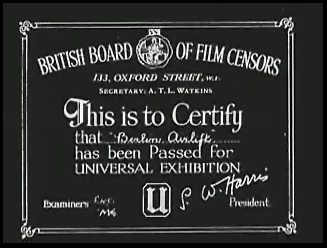
  • First nationwide film censor The British Board of Film Censors began operating. Nowadays many older people wish they’d censor more.

  • The value of British overseas investments 49% of net national wealth. 100 years on it is 65%.
  • Stainless Steel is invented by Harry Brearley in Sheffield. 100 years on, no one can imagine a world without it.
  • House of Commons rejects women's right to vote. Suffragette Emmeline Pankhurst sentenced to three years of penal servitude for demanding votes for women: Women over 30 would get voting rights only in 1918. In 2011, 400 000 people (half of them women) march for an alternative to the current socio-economic system.

  • The first woman magistrate Miss Emily Dawson appointed in London: Only in 2004, is Britain’s first Asian woman magistrate Revinder Johal appointed.
  • Margaret Cousins (Irish), suffragette, released form Tullamore Gaols: migrates to India and becomes India’s first woman magistrate in 1922. She was thrown again to prison in 1932 for protesting against the law curtailing free speech in India. The Indians actually never stopped talking.

France
  • The Mona Lisa is returned to France by Italy after Vincenzo Peruggia was caught trying to sell it to the Uffizi Gallery in Florence. Mona Lisa was displayed all over Italy until 30.12.1913. Art and cultural property crime is a $6 billion industry nowadays with major government and international agencies fighting against it. 
  • Suicide rate in France is 5.46 per 100 000. In 100 years it grows to the third highest figure in non-former Eastern bloc Europe (14.6 in 2010: double that of Britain and USA)
  • Hardly any car thefts in France, grows to the third highest car theft rate in the world in 100 years with 301, 539 thefts in 2010.


USA
  • The 16th Amendment to the constitution allows the Federal government to impose and collect income taxes. 100 years later a new word Taxmageddon is coined as government aims to make every household pay an extra $3,446 annually and collect  $536 billion to stem the deficit tsunami  
  • The world’s largest railway station, New York’s Grand Central Terminal is reopened. In 100 years, USA becomes the backwater of railroads compared to Japan, China and other countries.
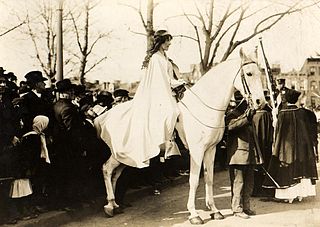
  • The Woman Suffrage Parade of 1913 is led by Inez Milholland riding on a white horse, with nine bands, four mounted brigades and celebrities like Helen Keller. Women gained the right to vote in national elections in 1920 (New Zealand in 1893 and Saudi Arabia not yet in 2013). Sarah Palin almost became Vice President in 2008.

  • Battle of Bud Bagsak – The Moro people, wielding spears and Kampilan Swords in the Philippines, including women and children are all killed by US troops led by General “Black Jack” Pershing. “Rather than impose a democratic system for which the people were unprepared, General Wood crafted a paternal system of government”. In 100 years the language would change to include terms like regime change, weapon of mass destruction, war on terrorism, enemy combatant, authorization for use of military force against terrorists, conditional detention etc.
  • The Federal Reserve System as the central banking system is created with three key objectives for monetary policy—maximum employment, stable prices, and moderate long-term interest rates: Very good dreams still to be realized 100 years later.
Photo source: Dromedary with one hump in Camel cigarette pack
  • Camel cigarettes are introduced. For the first half of the century it actually had a picture of a dromedary (with two humps) on the pack, which has now become a camel with one hump. It should be the opposite but no one really cares.

Photo source: Camel cigarette pack with two humps
  •  The hottest temperature ever recorded 134 °F (~56.7 °C) in Death Valley, California. Global warming becomes a hot topic 100 years later.


South Africa
  • Blacks are forbidden by the parliament of South Africa from owning or buying land from whites. 100 years later white poverty is blamed on Affirmative action reserving 80% of jobs for blacks and 450, 000 whites (10% of white population) live below poverty level. 
  • Mohandas Gandhi is arrested while leading a march of Indian miners. He will be arrested many times before he is killed in 1948. 100 years later, Indians have to commit serious crimes to get arrested in South Africa and do not become a Mahatma in India after getting arrested.


Uruguay
  • The Uruguayan Air Force is founded. They have not attacked anyone since.


Predictions About the Future Made in 1913 


London’s lord mayor, Sir Vansittart Bowater was spot on with his predictions in 1913: 
  • A horse will excite far more wonder and curiosity in London city than an aeroplane or a dirigible flying over St. Paul does today
  • The drone of great airships, each carrying perhaps many hundreds of passengers, will also probably be heard across both the Atlantic and the Pacific oceans
  • The channel tunnel scheme may be a commonplace of actuality, with train services running every few minutes direct from London to Paris

NASA scientist James Hansen predicted in 1988 that global temperature rise would be proportional to the rise in CO2 emissions. This is off by 150% in 2011.


Another prediction from Scientific American editor Waldemar Kaempfert, in 1913:
  • "Over [future] cities the aerial sentry or policeman will be found. A thousand aeroplanes flying to the opera must be kept in line and each allowed to alight upon the roof of the auditorium in its proper turn."


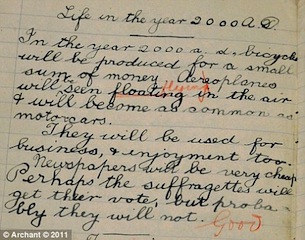
12 year old Edgar Codling of Hillington, Norfolk, UK was very much a visionary:
  • Aeroplanes will be seen floating in the air and would be as common as motorcars. They will be used of business and enjoyment too. 


US government National Intelligence Council (NIC) in 1997 was not that successful:
  • “The next 15 years will witness the transformation of North Korea and resulting elimination of military tensions on the peninsula”. 

Additional Sources:

The Transition in Eastern Europe, Volume 1. Olivier Jean Blanchard, Kenneth A. Froot, and Jeffrey D. Sachs, editors. University of Chicago Press, 1994