Showing posts with label Bhutan. Show all posts

Sunday, 12 July 2009

The Jihad Against the Smokers!

Some people have a perverse conviction that they know what is good for all the people. They try to convince everyone that by banning some activity we shall all live happily ever after.


Photo source: NHS campaign


What is wrong if some people are happy to use their penis for what they use it for?

Do all people want to live potent lives?

If some people live a healthy lifestyle in a manner prescribed by some experts, will this make everyone happy? Or shall we soon discover new ways of getting unhealthy and being unhappy?

Telling people to think with their penis is a tall order, even for people who think they have too short willies. 


Photo source:

In the first place, many people do not like to be told how to think with their brains either.

Despots and divine rulers do not need to justify their actions. Decisionmakers in democracies don’t have that privilege. They need scapegoats just like dictators and despots, but they have to justify their actions by the findings of "science". Smoking, especially second-hand-smoking or passive smoking is on the firing line in many countries.

The Nazis blamed the communists and Jews for introducing smoking to the German Aryan master race and trying to corrupt them (Proctor, 1999:179). Hitler (a heavy smoker who gave up smoking as a waste of money), personally believed smoking as decadent and a revenge of the Red Man against White Man (Proctor, 1999:219).


Modern Mechanism of Smoking Bans

Nowadays scientific studies by “independent” committees give the arguments. Then politicians deny that any measure for banning a popular activity like smoking is ever going to see the daylight. “Suddenly” comes the ban. But behind the scenes, a vampire army of lawyers in search of someone to sue has already been active and won landmark cases before any politician in his/her sane mind even thinks of a ban.

Britain’s public health minister Caroline Flint (who admitted smoking cannabis as a student but not liking it) said in June 2005 that any suggestion of a smoking ban was “false speculation”. Then the British parliament voted for total ban just nine months later.


Photo source:

Smoking (cigarettes, cigars, pipes, etc) is a universal habit nowadays. 

  • China is the king of the tobacco league – 30% of the planet’s 5,5 trillion cigarettes are produced and consumed in China. 
  • The USA comes second with 12% production, though tobacco is produced in about 100 countries globally. 
  • The largest tobacco company in the world, China National Tobacco Co. belongs to The State Tobacco Monopoly Administration or STMA, which is the organisation responsible for enforcing the tobacco monopoly in China. They don’t have even a website.

History of Smoking Bans


  • The first recorded ban on smoking is from 1575 in Mexico, when the Catholic Church bans tobacco usage in any form throughout the Spanish colonies.
  • The first country to ban smoking totally is Bhutan.
  • The first global ban is by Pope Urban VIII (1623-44). He threatened with excommunication anyone using tobacco (smoking or snuffing) in any holy place.
  • The first ban on using and cultivating tobacco is from China 1612.
  • The first death penalty for smoking is from 1617 in Mongolia. 
  • In Russia from 1634, for the first offence one got whipping, a slit nose and exile to Siberia and death sentence for the second offence.
  • The first use of the term “passive smoking” is by the Nazis.
  • The first building in the world to have a smoke-free policy was the wooden Old Government Building in Wellington, New Zealand in 1876 due to the threat of fire
  • The first country in the world to have a comprehensive nation-wide smoke-free workplace is Ireland with its law of 29th March 2004. 
Since the early 2000s most of the developed countries have some form of ban on smoking in public places.


Medieval Punishment Back in Anti Smoking


In some cultures like Finland, where they had the medieval punishment called pillory, anti-smoking has traces of the old punish-by-public-shaming element in it. Though these modern gas chambers are comfortable state-of-the-art in ventilation, the non-smokers can gaze publicly at the smokers practising their vice and feel holier for not being an addict of the vice.

Anyone really interested in the history of anti-smoking could read this excellent book Velvet Glove, Iron Fist by Christopher Snowdon. Little Dice; 415 pages.

I am not a smoker. I totally agree that passive smoking is a nuisance. Nowadays in countries with public smoking bans, your clothes don’t reek anymore if you go out and I appreciate that greatly.

But I am amused to see how smokers have suddenly become the underdogs and well, sinners have rights too. By the way, where is the government going to get revenues from if everyone stops smoking? Are they going to bring in taxes for breathing fresh air?

Which Countries Allow Public Smoking?


Photo source:

Where in the world is smoking in public allowed? Hardly anywhere, legally that is. These countries officially allowing smoking in public places are becoming rare.


  • Madagascar - Except in taxis and Antananarivo International airport and Air Madagascar Flights
  • Malawi - no legislation
  • Namibia - smoke free law planned
  • Romania - Bars and restaurants have to carry signs if they are smoking or non-smoking
  • Russia - No country-wide smoke-free law

Famous Sayings about Smoking


  • I kissed my first girl and smoked my first cigarette on the same day. I haven't had time for tobacco since. Arturo Toscanini

  • To cease smoking is the easiest thing I ever did. I ought to know because I've done it a thousand times. Mark Twain, attributed
  • I thought I couldn't afford to take her out and smoke as well. So I gave up cigarettes. Then I took her out and one day I looked at her and thought: "Oh well," and I went back to smoking again, and that was better. Benny Hill

References: 

  • Proctor, Robert (1999), The War on Cancer, Princeton University Press.


Wednesday, 24 September 2008

Why School Shootings Happen So Often in Affluent Cultures?

Why does school shooting happen? 

This unpredictable and senseless violence leaves a community wrecked and soul-searching in abysmal guilt. Politicians talk about gun-control, preventive measures and mental health issues for some time and then everything becomes business as usual with no answers or remedies.


Yet another school massacre at Kauhajoki in Finland, leaves a nation shell-shocked with grief.

Another round of analysis and questioning “Why again?” is followed by fault-finding, blame-shifting and political promises – all just before the upcoming communal elections.

Difference Between School Shooting and School Massacre

Photo source:

School shootings are isolated incidents of someone killing one or more persons with a firearm or a death resulting from a gang fight. 

School massacres, are mass killing rampages by usually lone gunmen like the one in Kauhajoki. 

Many people remember the tragedies at Columbine High, Virginia Tech and think that such rampages only happen in the USA. But these massacres happen in other wealthy and stable democracies too. 

The statistics of school shootings and massacres are horrendous and gruesome reading. Here is a site devoted to the Timeline of school shootings and massacres all over the world.


Motives of School Shooters


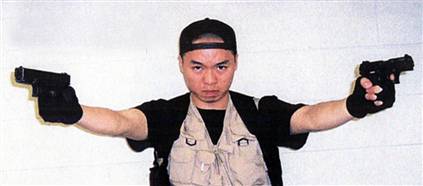
The Copycat Effect (term coined by the author of the book, Loreen Coleman), is said to be very crucial for the planning and motives of gunmen. Martin Bryant, the gunman responsible for the 1996 Port Arthur Massacre in Australia had studied and copied Thomas Hamilton, who massacred innocent children at Dunblane. 

Similarly, newspaper reports have hinted that Matti Saari, the killer of Kauhajoki, Finland copied Pekka-Eric Auvinen, the killer at Jokela, Finland a few months earlier. 


Photo source:

Martin Bryant had been diagnosed as mentally retarded with a low IQ and serious disorders. He had told neighbours "I'll do something that will make everyone remember me".

The catalysts for the school-shootings can be traced to a number of factors. Here is a screenshot from Jessie Klein's The Bully Society, a comprehensive study describing the school-shooting situation in USA.


What Can Society Do To Stop School Shootings

What does a society do to stop these killing rampages? Does it mean that we should go on a spree of arming schools with metal detectors, surveillance cameras and armed guards? 

The butchering at Mercaz HaRav Yeshiva religious school massacre in Israel was cut shot by one student, Yitzhak Dadon. He shot the gunman shooting with an AK-47 with his own pistol.
Photo source:

Do societies go on a witch hunt by profiling people who can and who cannot kill as in "The Classroom Avenger," James P. McGee and Caren R. DeBernardo, Forensic Examiner (May-June, 1999)?

The U.S. secret service has researched all the US school shootings and massacres as well as the foreign ones. They warn against any kind of student profiling for would-be killers. This kind of ‘profile’ would fit too many students and miss the real killers. Profiling is often misleading as a preventive measure, as we might be lulled into a false sense of security as some 'potential' types have been identified and they are being watched.

  • In the Concordia University massacre it was a dismissed assistant professor. 
  • Some American school massacre gunmen lived with both parents in "an ideal, All-American family." 
  • Others came from broken homes, or lived in foster homes. Significantly, a few were loners, but most had close friends. 
  • Some of them had been teased at school but most of them had not. 
  • The killer at École Polytechnique in Montreal, Canada separated his victims and killed only women (fourteen of them).

Can a society like Finland, which has the third highest number of guns in the world after USA and Yemen, decide to ban handguns? 

Gun controls were intensified in Scotland after Dunblane. but Guns haven’t been banned in USA after repeated school massacres and neither in Yemen after the Sanaa massacre in 1997. The Bushmaster AR-15 semi-automatic rifle, an extremely powerful weapon, often called a civilian version of the US Army M-16 assault rifle, was outlawed in 1994. But in 2004, US Congress gave in to the political clout of the gun-rights lobby and did not renew the ban. So a potent weapon of mass-destruction remains freely available for school shooters in USA.


Why Some People Become School Shooters?

The outcry in Finland after the Jokela massacre has been to increase the number of school psychologists. Many school killers had regular consultations with psychologists, but it didn’t stop them. In countries like India, Bolivia or Thailand with no school psychologists, school massacres fortunately haven’t happened.

Could the potential killer’s soul get poisoned by an inability to measure up to the demands of a society too bent upon achieving more and more? 

Can we blame a society for becoming too performance oriented, too materialistic so that human values take the back seat? 

Can we say that the people in a certain country are too busy and have become cold?


The social system in rich countries takes care of people and responds to situations. But systems function with cold efficiency and can never have human warmth. Here are some disturbing questions that emerge after every such tragedy, but are soon overlooked as they become 'uncomfortable' questions.
  • Can more of the 'system' reach out and touch the lost ones? 
  • Can a professional shrink reach lonely children if the parents are too busy chasing results in their jobs? 
  • Does it help if doctors prescribe stimulants for depressed people with no reason to live and let live?

Could the inner recesses of a potential killer become devoid of human warmth, dignity and respect so that the only way to escape that persistent laceration of self-hatred is to feel oneself superior by using weapons? 

Helsingin Sanomat, the leading newspaper in Finland put the killer's picture on the front page in place of the usual ads. In 25 years the only other time news replaced ads was the 9/11 terrorist attacks. If you murder 10 innocent people, the leading paper of the land recognizes you as a major celebrity. This is media-sponsored pandering to egoism at its worst.
When religious myths do not speak to us any more, when social structures like marriage and family start to crumble, what else can fill in the vacuum of values but a mythology of hatred and violence?

Should we recognize that in spite of all the progress and riches, in many countries, it is the end of living and the beginning of survival for many? Neither a Mink coat nor the flame from the muzzle of a gun can save you from the cold embrace of death when your heart is frozen. You need care and love from people to remain a warm human being. Since when do systems give that!

Rather than running after PISA rankings to measure school efficiency, should schools teach students how to live good lives?


Should richer countries seriously start to measure success and prosperity by Gross National Happiness like in Bhutan? 

The Fourth International Conference on Gross National Happiness will be held 24-26 November 2008 in Thimphu, Bhutan.

Further reading: Klein, Jessie, (2012) The Bully Society: school shootings and the crisis of bullying in America’s schools, New York, NY: NYU Press, http//:www.nyu-press.org/bullysociety/dataonschoolshootings.pdf.