Showing posts with label nazis. Show all posts

Thursday, 25 February 2010

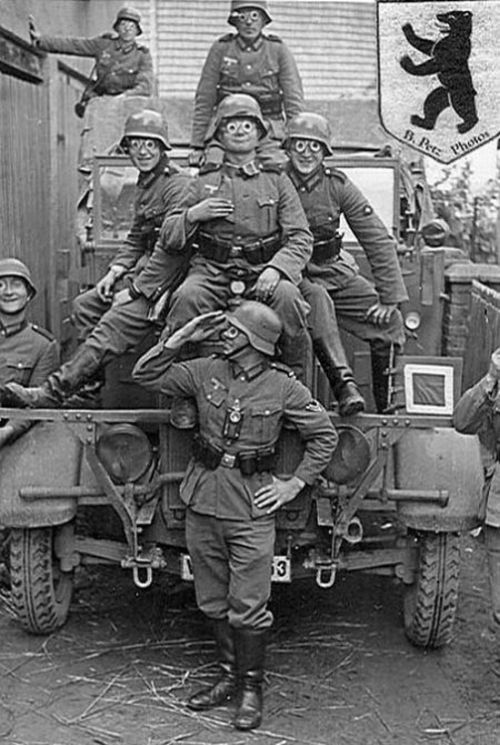
Why Were the Germans Called Huns in Both the World Wars?

Wars are always horrendous. In wars both sides lie, cheat and use propaganda to debase the opponents.

In WWI and WWII both sides called each other derogatory names. The Allies used the derogatory names Fritz, Jerry, Hun, Heinies, Kraut, Nazi, Boche (WWI) etc. for the Germans. The Germans called the Americans Ami, the Russians Iwan and Brits Tommy. Among Allies, the French were frogs and the Australians were diggers


The Germans are called Moffen in Flanders and Les Boches in Wallonia, the Austrians called them Fritzen etc. Ordinary Germans called high-ranking Nazis Goldfasan. Luftwaffe pilots called enemy fighter planes Indianer (from the cowboys and Indians game).


Why did the British call the Germans Huns in both the world wars?

Does it come from Attila the Hun? Is there a suggestion that the soldiers on the German side were more ruthless and unstoppable like Attila the Hun’s hordes?

Especially in WWI, when there were no Nazis, no side was caught with mass tortures in concentration camps or other nasty things and both sides played by the same ruthless rules of war, the derogatory name Hun was used for the Germans, why?

Theories of the Origin of the Derogatory Name Hun for Germans

There are two theories. According to one, the German soldiers’ belt carried the motto Gott Mit Uns. The Brits deliberately mistook the word Uns for Huns.


In WWI, the Allied propagandists noticed that the German soldier’s helmet with the pointed Pickelhaube resembled the ancient Hun pointed headdress and exploited this dramatically to paint them as ruthless and barbaric.


The US Army was very skilful to exploit this Hun image to instill fear and get more recruits.


The second theory puts the blame totally on Kaiser Wilhelm II. During the Boxer Rebellion in China he wanted to scare the living daylight out of the Chinese for all eternity and gave the order in his notorious speech Hunnenrede (The Hun Speech) to the German Expeditionary Corps leaving from Bremerhaven on 27th July 1900 to quell the Boxer Uprising in China. Peter Lubrecht Sr.'s excellent book Liebe Kück!: A German Soldier’s Story (2015) p.30 from the Great War narrates the story.
"When you meet the enemy, he will be defeated! No quarter will be given! No prisoners will be taken! 
Those who fall into your hands are forfeit to you! Just as a thousand years ago, the Huns under their King Etzel made a name for themselves that make them appear awe-inspiring in tradition and myth, so shall you establish the name of Germans in China for a 1000 years, so that a Chinese will never again dare to look askance at a German." Source of quote:
Current German Attitudes Towards War - Vergangenheitsbewältigung

Many people would automatically equate Nazi aggression with Germany. But even they would have to admit the burden of guilt most Germans still feel about the past atrocities and the official apologies Germany has given repeatedly. 

The Germans have a word vergangenheitsbewältigung, which means "the struggle to overcome the negatives of the past". This is a rather common feature of post 1945 German literature and culture in general. However, the same term can also refer to excesses and human rights abuses in the former communist East Germany or DDR (Berdahl, 1999).


Many people (some of them very jealous of how Germany has rebuilt itself after two World Wars and become almost the richest and strongest country in Europe) think that the Marshall Aid given to war-torn European countries by USA went towards the reconstruction of Germany. In reality UK (3297 Million US Dollars) got three times more than Germany (1448 Million US Dollars), yet Germany has become the most prosperous nation in Europe without a single act of aggression used by the state against other nations since WWII. Anyone with even a scant knowledge of history could point out how UK stands apart.

Beside Germany, no other country involved in the world wars has made guilt and shame for past atrocities so obvious and visible in their culture. According to the most recent polls, almost 70% of Germans now want their troops to pull out of Afghanistan. The Germans reluctantly agreed to send soldiers to Afghanistan under serious pressure from USA, where only 58% oppose the war.
"The war is so unpopular that politicians won't even call it a war," said Alan Posener, political correspondent for the German daily newspaper Die Welt.


Alistair Urquhart from Aberdeen, Scotland, who survived horrendous Japanese prisoner of war camps and the Nagasaki atomic bomb blast recently wrote in his book, The Forgotten Highlander: One Man's Incredible Story Of Survival During The War In The Far East that Germany has atoned for its crimes and young Germans are taught about them but Japan has not and does not teach its young about the past horrors. 

Japan being blissfully in denial about WWII atrocities is not entirely true. 

Photo source:

Japan's Crown Prince Naruhito, who became the Emperor of Japan in 2019, stressed the importance of not whitewashing the atrocities of the past, by saying publicly: 
"It is important to look back on the past humbly and correctly."
The current wars in Iraq and Afghanistan have been going on for so long that people are used to the pro-war "information". But are all the people deadened in their conscience? In USA, there is a fair amount of resistance among the young people against the Afghanistan war and military recruitment as this video shows.

Source: Berdahl, Daphne (1999). Where the World Ended: Reunification and Identity in the German Borderland. Berkeley, CA: University of California Press. p. 215.

https://www.nbcnews.com/news/world/world-war-ii-should-not-be-forgotten-japans-prince-naruhito-n311561


Sunday, 12 July 2009

The Jihad Against the Smokers!

Some people have a perverse conviction that they know what is good for all the people. They try to convince everyone that by banning some activity we shall all live happily ever after.


Photo source: NHS campaign


What is wrong if some people are happy to use their penis for what they use it for?

Do all people want to live potent lives?

If some people live a healthy lifestyle in a manner prescribed by some experts, will this make everyone happy? Or shall we soon discover new ways of getting unhealthy and being unhappy?

Telling people to think with their penis is a tall order, even for people who think they have too short willies. 


Photo source:

In the first place, many people do not like to be told how to think with their brains either.

Despots and divine rulers do not need to justify their actions. Decisionmakers in democracies don’t have that privilege. They need scapegoats just like dictators and despots, but they have to justify their actions by the findings of "science". Smoking, especially second-hand-smoking or passive smoking is on the firing line in many countries.

The Nazis blamed the communists and Jews for introducing smoking to the German Aryan master race and trying to corrupt them (Proctor, 1999:179). Hitler (a heavy smoker who gave up smoking as a waste of money), personally believed smoking as decadent and a revenge of the Red Man against White Man (Proctor, 1999:219).


Modern Mechanism of Smoking Bans

Nowadays scientific studies by “independent” committees give the arguments. Then politicians deny that any measure for banning a popular activity like smoking is ever going to see the daylight. “Suddenly” comes the ban. But behind the scenes, a vampire army of lawyers in search of someone to sue has already been active and won landmark cases before any politician in his/her sane mind even thinks of a ban.

Britain’s public health minister Caroline Flint (who admitted smoking cannabis as a student but not liking it) said in June 2005 that any suggestion of a smoking ban was “false speculation”. Then the British parliament voted for total ban just nine months later.


Photo source:

Smoking (cigarettes, cigars, pipes, etc) is a universal habit nowadays. 

  • China is the king of the tobacco league – 30% of the planet’s 5,5 trillion cigarettes are produced and consumed in China. 
  • The USA comes second with 12% production, though tobacco is produced in about 100 countries globally. 
  • The largest tobacco company in the world, China National Tobacco Co. belongs to The State Tobacco Monopoly Administration or STMA, which is the organisation responsible for enforcing the tobacco monopoly in China. They don’t have even a website.

History of Smoking Bans


  • The first recorded ban on smoking is from 1575 in Mexico, when the Catholic Church bans tobacco usage in any form throughout the Spanish colonies.
  • The first country to ban smoking totally is Bhutan.
  • The first global ban is by Pope Urban VIII (1623-44). He threatened with excommunication anyone using tobacco (smoking or snuffing) in any holy place.
  • The first ban on using and cultivating tobacco is from China 1612.
  • The first death penalty for smoking is from 1617 in Mongolia. 
  • In Russia from 1634, for the first offence one got whipping, a slit nose and exile to Siberia and death sentence for the second offence.
  • The first use of the term “passive smoking” is by the Nazis.
  • The first building in the world to have a smoke-free policy was the wooden Old Government Building in Wellington, New Zealand in 1876 due to the threat of fire
  • The first country in the world to have a comprehensive nation-wide smoke-free workplace is Ireland with its law of 29th March 2004. 
Since the early 2000s most of the developed countries have some form of ban on smoking in public places.


Medieval Punishment Back in Anti Smoking


In some cultures like Finland, where they had the medieval punishment called pillory, anti-smoking has traces of the old punish-by-public-shaming element in it. Though these modern gas chambers are comfortable state-of-the-art in ventilation, the non-smokers can gaze publicly at the smokers practising their vice and feel holier for not being an addict of the vice.

Anyone really interested in the history of anti-smoking could read this excellent book Velvet Glove, Iron Fist by Christopher Snowdon. Little Dice; 415 pages.

I am not a smoker. I totally agree that passive smoking is a nuisance. Nowadays in countries with public smoking bans, your clothes don’t reek anymore if you go out and I appreciate that greatly.

But I am amused to see how smokers have suddenly become the underdogs and well, sinners have rights too. By the way, where is the government going to get revenues from if everyone stops smoking? Are they going to bring in taxes for breathing fresh air?

Which Countries Allow Public Smoking?


Photo source:

Where in the world is smoking in public allowed? Hardly anywhere, legally that is. These countries officially allowing smoking in public places are becoming rare.


  • Madagascar - Except in taxis and Antananarivo International airport and Air Madagascar Flights
  • Malawi - no legislation
  • Namibia - smoke free law planned
  • Romania - Bars and restaurants have to carry signs if they are smoking or non-smoking
  • Russia - No country-wide smoke-free law

Famous Sayings about Smoking


  • I kissed my first girl and smoked my first cigarette on the same day. I haven't had time for tobacco since. Arturo Toscanini

  • To cease smoking is the easiest thing I ever did. I ought to know because I've done it a thousand times. Mark Twain, attributed
  • I thought I couldn't afford to take her out and smoke as well. So I gave up cigarettes. Then I took her out and one day I looked at her and thought: "Oh well," and I went back to smoking again, and that was better. Benny Hill

References: 

  • Proctor, Robert (1999), The War on Cancer, Princeton University Press.