The advertisement "There’s probably no God. Now stop worrying and enjoy your life.” runs on 200 buses in London and 600 vehicles in England, Scotland and Wales in an advertising campaign. The atheist Professor Richard Dawkins and the British Humanist Association officially back this anti-God campaign.

Bus driver Ron Heather, from Southampton, Hampshire, UK walked out of his shift on Saturday in protest. His employer, the bus company, First Bus said in a statement:
"As an organisation we don't endorse any of the products or sentiments advertised on our buses. The content of this advert has been approved by the Advertising Standards Agency and therefore it is capable of being posted on static sites or anywhere else."

Hanne Stinson, chief executive of the British Humanist Association, expressed:
"I have difficulty understanding why people with particular religious beliefs find the expression of a different sort of beliefs to be offensive. "I can't understand why some people seem to have a different attitude when it comes to atheists."
Do States Define the Religions of its Citizens?
Is this ad inherently different from the message of organised religions? A building, a church, a temple, or a mosque is also a loud proclamation of the faith of believers. Buildings and religious congregations satisfy the needs of members, but without attacking other people faiths. Stating your viewpoint and professing your faith need not undermine or attack anyone else’s faith.

Most countries of the world are tolerant of different religions or religious views of inhabitants. States have however, often taken extreme positions of intolerance. For example, on February 27, 380 AD, the Byzantine emperor declared, "Catholic Christianity" the only legitimate imperial religion, ending state support for the traditional Roman religion and tolerance for others.
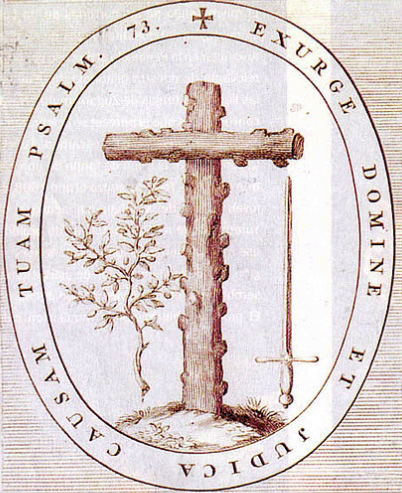
Track Record of the Catholic Inquisition
The Catholic inquisition is seen as a very bloody and gruesome affair.
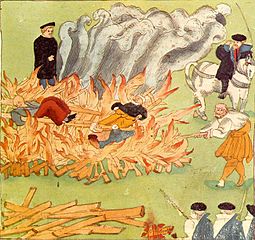
30 external historians working together with Vatican authorities, however found that more women accused of witchcraft died in the Protestant countries than under the inquisition.
Track Record of the Catholic Inquisition
The Catholic inquisition is seen as a very bloody and gruesome affair.
30 external historians working together with Vatican authorities, however found that more women accused of witchcraft died in the Protestant countries than under the inquisition.

Outside Europe, the inquisition was a different story. The Goa inquisition, between 1560 and 1812, was designed to punish relapsed New Christians (Jews and Muslims). From the scant records not destroyed in 1812, it seems to have brought to trial 16 200 out of which 64 were burned and 57 executed.
The Inquisition Symposium, established in 2000 by the Pope, found that the Inquisition burned 59 women in Spain, 36 in Italy, and four in Portugal. At the same time in Europe, civil justice brought to trial 100,000 women and burned 50,000 of them. About 26,000 were condemned as witches in Germany.
,+by+Johann+Jakob+Wick.jpg)
Theocratic States in the World Today
Though in Norway, Finland and Sweden the Lutheran Church and the state are joined, currently only Islamic states are theocratic. Saudi Arabia requires all Saudi nationals to be Muslims. The state recognizes individuals’ rights of non-Muslims to worship in private. Israel is also a Jewish theocracy, with a population 76.1% Jewish, 16.2% Muslim, 2.1% Christian, and 1.6% Druze, with the remaining 3.9% of other religions. But, Israel allows freedom of religion by law even to Israeli citizens.

The first modern Islamic state, Pakistan was founded on 14th August 1947. According to Section 295C of the Pakistan Penal Code you get the death penalty if you
"by words . . . or visible representation . . . or by any imputation, innuendo, or insinuation, directly or indirectly, defile the name of the Holy Prophet Muhammad."You can be sent to ten years in jail for outraging the religious feelings of any group. As of mid-2002, only the testimony of a single Muslim is sufficient to prosecute a non-Muslim on blasphemy charges.
Religion of Ruler Defined by Law
There are only few countries where the religion of the ruler is defined by law.
- Saudi Arabia requires all Saudi nationals to be Muslims. As a ruler of Saudi Arabia has to be a Saudi national, the ruler has to be a Muslim.
- The Supreme Leader of the Islamic Republic of Iran with its Shi’a Islam of the Jaafari (Usuli) school of thought also has no choice about religion.

- The Emperor of Japan is currently the only ruler with the title of Emperor. In 1946, with pressure from US General MacArthur, he renounced his claim to being divine in human form (akitsumikami), but he did not renounce being a Aahitogami (a Kami or spirit being born in human form) or a descendant of Amaterasu (Sun Goddess in Shinto religion).
The 44th US president Barack Obama can convert to Islam, Hare Krishna, Bahái, or any other faith. But, one other very liberal Western democracy has a religious straightjacket for its ruler. The constitutional law prevents the monarch of UK from being a Catholic. As the head of the Anglican Church and as the “Defender of Faith”, the monarch cannot but be an Anglican Protestant officially. This could be a toughie for Prince Charles (with his holistic views and penchant for alternative 'treatments') when his time comes.

Further References:
- Peter Wetzler, Hirohito and War, University of Hawai'i press, 1998, p.3
- Encyclopaedia Britannica Online. Encyclopaedia Britannica, Inc.
- Encyclopædia Iranica. Center for Iranian Studies, Columbia University.
-
Levack, Brian P. The witch hunt in early modern Europe, Third Edition. London and New York: Longman, 2006.
-
Monter, William: Witch trials in Continental Europe, (in:) Witchcraft and magic in Europe, ed. Bengst Ankarloo & Stuart Clark, University of Pennsylvania Press, Philadelphia 2002, pp 12.
- Salomon, H. P. and Sassoon, I. S. D., in Saraiva, Antonio Jose. The Marrano Factory. The Portuguese Inquisition and Its New Christians, 1536-1765 (Brill, 2001), pp. 345-7.


 . Finland ratified this agreement on 7