Sunday, 9 August 2009

How Does Your Religion Determine Your Hell?

Do you believe in a Hell and Heaven? 

You’d be surprised at the differences in the concepts of Hell in different religions across the world. The similarities are also fascinating.


Whether Hell exists physically or not is yet another taboo subject like the size, of one’s paycheck. Recently the 79-year-old Pope Benedict said that the Christian Hell was indeed a physical place. 


"… Hell, about which little gets said today, exists and is eternal for those who shut their hearts to His love."

Most Americans Believe They Are Going to Heaven and not Hell!


A national poll by the Barna Research Group in USA reveals:


  • 75% of Americans believe that they will go to heaven after dying
  • 1% admitted that Hell would be their next destination after dying
  • 39% believe that Hell is being eternally separated from God’s presence
  • 32% believe that it is an actual place of eternal torment and suffering
  • 13% described Hell as “unknown bad outcome after death.”

Photo source Shocking and gruesome photo of American soldier killed by car bomb in Afghanistan


Concept of Hell in Different Religions


Presented in alphabetical order, as all religions are equally valid and valuable paths for its followers and we should respect this.

African Religions – No Hell in most African religions. Afterlife is a ”land” very similar to this world.

Aztecs - Mictlán, the ninth and lowest level of the underworld, was a physical place in the north. Everyone who died, except warriors dying in battle, women in childbirth and those struck by lightning had to take the four-year journey to Mictlán.


Photo source:

Bahá'í Faith – Hell is only symbolic. When we are spiritually farthest from God, we are in Hell.


Photo source: Wikimedia Commons


BuddhismNaraka, like Hinduism is the lowest of the realms of the afterlife. It is not for all eternity. Bodhisattvas like the female Ksitigarbha visit Naraka to teach and free residents of Naraka, who eventually can become Buddhas.


Chinese Hells – Move over Abu Ghraib! Someone from a government bureaucracy with a background in social security and law must have designed the Chinese Hell. There are 18 types or subtypes for each type of punishment. 

There are various sections:

  • Chambers of Maggots
  • Chambers of Eye-Gouging, 
  • Chambers of Disembowelment, 
  • Chambers of Tongue Ripping
designed for 

  • “peeping toms”
  • “people who force good women into prostitution” 
  • “crooks who use loopholes in the law to cheat and engage in malpractice”. 


Christianity – A physical place where evildoers suffer torment and wait for the Last Judgement. Some Christians believe that Hell is only symbolic, meaning separation from God; while for others it is eternal damnation. 

Most graphic descriptions are of the Christian Hell are by Dante Alighieri and Hieronymus Bosch.


Photo source:

Hinduism - No concept of linking Hell with Final Judgement as in Christianity, Islam and Judaism. Naraka is rather a place for purification rather than punishment or retribution. 


Swami Vivekananda explains: 
"There are heavens, there are hells, there are earths, but they are not permanent. If I am sent to hell, it is not permanent. The same struggle goes on and on whatever I am. How to go beyond all this struggle is the problem. The Indian idea is not to go to Heaven. Get out of this earth, get out of hell, and get out of heaven! What is the goal? It is freedom! You must be free" (Swami Vivekananda Complete Works 6:57)
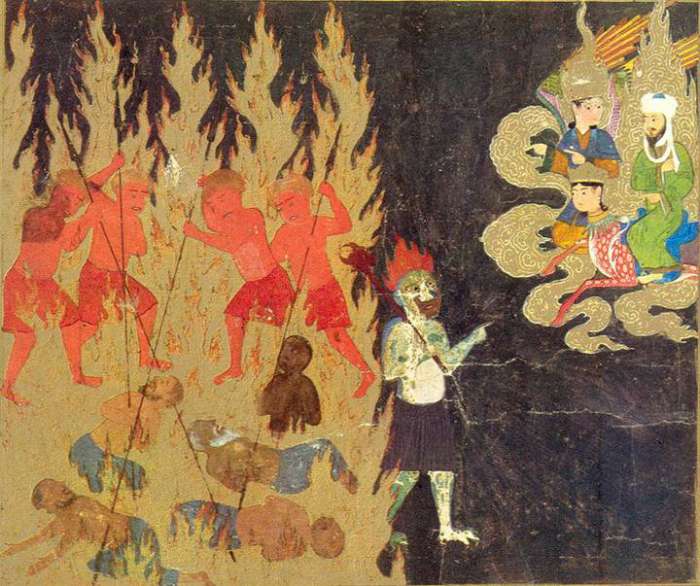
IslamJahannam in Islam is the Hell for the vilest tortures and damnations ever conceived and torture is ”earned” according to how much evil you did while alive. 

Zamhareer is a special ice-cold section reserved for the hypocrites and for Shirk, which is the sin of polytheism or worshipping other form of divinity than Allah.


Photo source:


JudaismSheol is the underworld, more like a waiting and questioning room for everyone who dies. Gehenna, a dark, silent and dusty place, is where the evil people get the full treatment of torment and damnation. Judaism also has traditions of considering Hell to be a state of suffering rather than a place.


Photo source:

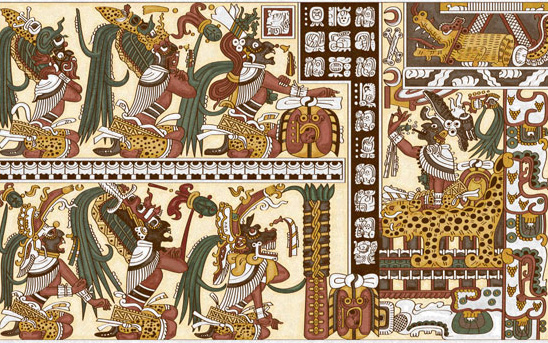
MayaXibalbá was the nine-levelled underworld ruled by demons. The shamans would banish diseases to Metnal, the lowest level. The road out was steep, thorny and extremely hard.


Photo source:

Mormons – Hell is physical but evildoers can get out when the sentence is served. Outer Darkness is a holding tank for wicked souls. Only those who repeatedly fail to be resurrected return there for eternity.


Photo source:

Native American – Great imagination at work here.


  • The Assinniboin and Athapascan tribes believed that Hell was a land of perpetual ice and snow in the north, where there was nothing desirable. 
  • The Sapona tribe believed that Hell was full of ugly women, who attacked men constantly with their unbridled passions shouting only in shrill tones. 
  • For the Natchez, Hell was covered with water. The soul was left naked in Hell to mosquitoes and the only food was spoiled fish.
Scientology – No Hells. So don't expect Hollywood celebrities as judges or guides.

Sikhism – No hell or heaven. Upon death, we merge back into the universal nature, as a drop of rain into the ocean. Hell on earth is seen as the suffering of pain caused by ego.

ShintoYomi is a physical place, with its entrance in the Izumo province, where everyone goes after death. Izanami, the goddess of creation and death rules in Yomi, which is more like a purification place than punishment.


Photo source:

Zoroastrianism – Vague mention of Hell as a place. Hell residents freed by three saviours at thousand year intervals.

7th Day Adventists – Wicked people sleep in the grave till the Last Judgement at the end of the world, when Jesus will cast them to Hellfire.


Read more about Dante’s description of the Christian Hell.

Take the online test to discover your level in the Christian Hell - HERE


Friday, 31 July 2009

Are Juries More Leninent Than Judges?

Get your case in front of a jury rather than a judge, and you have much better chances of an acquittal, more so if you belong to an ethnic minority. Is this really true?


Photo source:


Jurors or laymen and women are chosen for their integrity and law abiding conduct to help judges. Juries usually decide questions of fact while professional judges, with suitable training and experience, decide questions of law.

Jury trials have been around since the Athenian democracy (500 B.C). In ancient Athens, trials were public spectacles. 500 jurors, called
dikaste, decided capital cases involving death and upto 1500 dikaste decided property cases.


Though it has a special place in the British and American legal systems, Britain now wants to ban jury trials for serious fraud and some other inquests. Germany scrapped the jury system in 1924, as they did not see it as fair. Russia, in 2008, banned jury trials for terrorism and treason cases.

Photo source:

In Islamic law countries, 12 members citizen’s juries are widely used today. Surprisingly China, Japan and South Korea are allowing more jury trials in order to increase the impartiality and independence of the legal systems.


Juries are More Lenient Than Magistrates


A study by researchers at the Legal Research Institute, University of Warwick, based on a racially mixed sample of defendants in London, Birmingham, Leeds and Bradford shows that:

  • Defendants who took their cases to jury trial were much more likely to be acquitted than those who elected to be tried before magistrates.
  • Ethnic minority defendants expressed much greater confidence in trial at Crown Court, and in juries, than in magistrates. Magistrates were seen as biased in favour of the police. Juries, especially if they had ethnic minority members, were considered more likely to balance out any individual prejudices against black defendants.


Photo source:


Jurors in Britain Are Kinder on Ethnic Minority Defendants


Jurors in British trials are more likely to be lenient to defendants from minority backgrounds. Researchers from the University of Birmingham found that the British jury system does not discriminate against those from black and minority ethnic (BME) backgrounds. 

On the contrary, there is a tendency to compensate for perceived biases in the criminal justice system. The UK Ministry of Justice (MoJ) commissioned the research, which also found that white and black people reacted the same when summoned for jury service.


Photo source:

How Juries Can Get Things Wrong


What you see on television affects you, even as a juror. The csi-effect, where TV shows distort the role of forensic evidence in solving cases affects juror behaviour greatly. The National Institute of Justice, USA research shows that jurors often have unrealistic expectations.
  • 46 % expected to see some kind of scientific evidence in every criminal case.
  • 22 % expected to see DNA evidence in every criminal case.
  • 36 % expected to see fingerprint evidence in every criminal case.
  • 32 % expected to see ballistic or other firearms laboratory evidence in every criminal case.
Photo source:

The case of Rodney King is another example of the different ethnicity of jury members affecting their perception negatively. 

The jury, consisting of ten whites, one Latino and one Asian acquitted three white police officers though there was compelling evidence of police brutalilty on videotape. This miscarriage of justice led to the Los Angeles riots of 1992 resulting in 52 death and 2,383 injuries, more than 7,000 fires, damages to 3,100 businesses, and nearly $1 billions in damages.


Photo source:


Complex issues like rape are very confusing even for experts of the field and jurors need better guidance from judges and experts on how to understand victim behaviour. 

Research by Professor Vanessa Munro of The University of Nottingham and Dr Louise Ellison of the University of Leeds found jurors have a poor understanding of the ways in which women may react when raped, the degrees and types of injuries they might sustain and the different behaviours they might display in the witness box.


What Do Jurors Typically Expect?


Jurors expect all rape victims to:

  • Fight back against the rapist
  • Have serious physical injuries
  • Report the offence immediately
  • Appear tearful and distressed when recounting their experiences in court.
In reality, rape victims may not always behave in such manner.

Media Can Affect Jurors Easily


India abolished the jury system in 1959, after the sensational trial of Naval Commander Kawas Manekshaw Nanavati for murdering the lover of his English wife. 

The jurors saw the handsome man as representing a wronged husband and found him not guilty with an 8-1 verdict but the judge referred the case to the Bombay high court. The High Court and the Supreme Court sentenced him to life imprisonment.


Photo source:

In Spain, where there is not much faith in the jury system, the
Wanninkhof case of 1999, was a miscarriage of justice by jurors. 


The jurors found Dolores Vázquez, the lesbian lover of Alicia, the mother of the murdered 19-year old girl Rocío Wanninkhof guilty because the media painted her so. The real killer was later found to be an Englishman, Tony Alexander King.


Photo source:


Jury Decisionmaking Models Not Very Reliable


Can you predict easily how a certain jury will sentence the accused?


Research by Tanya S. Taylor and Harmon M. Hosch of the Department of Psychology, University of Texas at El Paso, El Paso, Texas, USA, found that all theoretical models for predicting the outcomes of jury decisionmaking are only models. 

Photo source:

The relationships among juror and defendant characteristics and their influence on trial outcomes are extremely complex and cannot be forecasted. Case strength, defendant ethnicity, and jury composition were related to sentence lengths. So, it's a mixed outcome!


Monday, 20 July 2009

Poor or rich enough - Is Your Income Enough for You?

Is the money you earn enough for you? – Somewhat quasi-scientifically, I’ve been asking this question from people I meet. They don’t have to disclose the income, but just answer if they are satisfied with their income. The hundreds (over 500) of people I’ve talked to, from all income levels, age groups, professions and ethnicities, both men and women; have generally said “It’s never enough. I could do with more.” What does this tell about humans?

Just a few (5%) have said that “Yes, I earn more than I need. Actually I don’t need all this.”

Now I wonder which is more surprising - the shortage of people happy with what they earn or that there are even this many?

Photo source: Wikimedia commons


How High is Your Income?

The median annual family income in USA is around 46 000 US $. This is only 5,02 cms of US $ 100 bills.


The richest American, Bill Gates, with around $ 50 Billion (now that he’s poorer due to the recession) would reach a height of over 50 km if he piled his wealth in 100$ bills. It is impossible for him to convert his wealth into banknotes as there are only 2 billion US$ bills in circulation. The US Treasury wouldn’t be too eager to print more for him as printing a new $ bill costs $8.02.

Mr Bill Gates could probably reach the moon if he piled his wealth using Zimbabwean dollars.

You can calculate the height of your annual income easily.

  • First convert your annual income to US dollars. One US dollar bill is 0.010922 cm thick. 
  • Then calculate how many 100 US dollar bills (use 1 US dollar bills if you are in teaching, taking care of the sick and the old or are a writer in India or Namibia) you get per year 
  • Multiply that amount by 0.010922 cm to get your annual income height in cms.

Earning More than Others is Important


Photo source:

Rather than the actual earning, the relative earning or comparative spending power is more important for many people, especially younger and ambitious men. In societies like the USA, raw money power is measured by conspicuous consumption. This trend has spread to former Eastern Block countries including China.

In societies, like the Scandinavian welfare societies, where incomes are more evenly distributed, people compare their incomes less with their neighbours. But they compare instead with history.
“I earn much more than my father.” or “My grandfather could never have afforded what I can.” are often typical sentiments.
Economists measure inequality among people in societies with measures like the Gini, Theil and Hoover Index (also called the Robin Hood index). Hoover Index measures the total community income that would have to be taken from the richer half of the population and given to the poorer half so that perfect equality is achieved.


Women Complain About Earning Less


Photo source

Women in Western democracies persistently complain that they earn less than men.

Is that a fact?

The research findings of the Institute of Economic Affairs, a UK free market think tank since 1955, are startling:
  • Women’s mean part-time earnings are now higher than those of male part-timers.
  • 22-29 year old women earn only 1% less than men
  • Men tend to work longer hours and put in more overtime, with twice as many male as female managers working more than 48 hours a week.
  • Typically men seek higher pay and career success and women seek job satisfaction.
  • 75% of women plan to take a career break against 12% of men.
  • Men lose their jobs more often and get injured more often at work.


Yet another research finding discloses that in USA, female graduates earn $8,000 less than men per year a year after graduating. Men earned $42,918, women earned $35,296 in 2009.

Famous Quotes About Income


Photo source:

“When there is an income tax, the just man will pay more and the unjust less on the same amount of income.” Plato, Greek Philosopher (428 – 348 B.C.)
“Expenditure rises to meet income.” C. Northcote Parkinson (English writer 1909-1993)
“Good management is better than good income.” Portuguese proverb. 
“Between persons of equal income there is no social distinction except the distinction of merit. Money is nothing: character, conduct, and capacity are everything. There would be great people and ordinary people and little people, but the great would always be those who had done great things, and never the idiots whose mothers had spoiled them and whose fathers had left them a hundred thousand a year; and the little would be persons of small minds and mean characters, and not poor persons who had never had a chance. That is why idiots are always in favour of inequality of income (their only chance of eminence), and the really great in favour of equality.” George Bernard Shaw (1856-1950). Irish playwright and 1925 Nobelist.

Sunday, 12 July 2009

The Jihad Against the Smokers!

Some people have a perverse conviction that they know what is good for all the people. They try to convince everyone that by banning some activity we shall all live happily ever after.


Photo source: NHS campaign


What is wrong if some people are happy to use their penis for what they use it for?

Do all people want to live potent lives?

If some people live a healthy lifestyle in a manner prescribed by some experts, will this make everyone happy? Or shall we soon discover new ways of getting unhealthy and being unhappy?

Telling people to think with their penis is a tall order, even for people who think they have too short willies. 


Photo source:

In the first place, many people do not like to be told how to think with their brains either.

Despots and divine rulers do not need to justify their actions. Decisionmakers in democracies don’t have that privilege. They need scapegoats just like dictators and despots, but they have to justify their actions by the findings of "science". Smoking, especially second-hand-smoking or passive smoking is on the firing line in many countries.

The Nazis blamed the communists and Jews for introducing smoking to the German Aryan master race and trying to corrupt them (Proctor, 1999:179). Hitler (a heavy smoker who gave up smoking as a waste of money), personally believed smoking as decadent and a revenge of the Red Man against White Man (Proctor, 1999:219).


Modern Mechanism of Smoking Bans

Nowadays scientific studies by “independent” committees give the arguments. Then politicians deny that any measure for banning a popular activity like smoking is ever going to see the daylight. “Suddenly” comes the ban. But behind the scenes, a vampire army of lawyers in search of someone to sue has already been active and won landmark cases before any politician in his/her sane mind even thinks of a ban.

Britain’s public health minister Caroline Flint (who admitted smoking cannabis as a student but not liking it) said in June 2005 that any suggestion of a smoking ban was “false speculation”. Then the British parliament voted for total ban just nine months later.


Photo source:

Smoking (cigarettes, cigars, pipes, etc) is a universal habit nowadays. 

  • China is the king of the tobacco league – 30% of the planet’s 5,5 trillion cigarettes are produced and consumed in China. 
  • The USA comes second with 12% production, though tobacco is produced in about 100 countries globally. 
  • The largest tobacco company in the world, China National Tobacco Co. belongs to The State Tobacco Monopoly Administration or STMA, which is the organisation responsible for enforcing the tobacco monopoly in China. They don’t have even a website.

History of Smoking Bans


  • The first recorded ban on smoking is from 1575 in Mexico, when the Catholic Church bans tobacco usage in any form throughout the Spanish colonies.
  • The first country to ban smoking totally is Bhutan.
  • The first global ban is by Pope Urban VIII (1623-44). He threatened with excommunication anyone using tobacco (smoking or snuffing) in any holy place.
  • The first ban on using and cultivating tobacco is from China 1612.
  • The first death penalty for smoking is from 1617 in Mongolia. 
  • In Russia from 1634, for the first offence one got whipping, a slit nose and exile to Siberia and death sentence for the second offence.
  • The first use of the term “passive smoking” is by the Nazis.
  • The first building in the world to have a smoke-free policy was the wooden Old Government Building in Wellington, New Zealand in 1876 due to the threat of fire
  • The first country in the world to have a comprehensive nation-wide smoke-free workplace is Ireland with its law of 29th March 2004. 
Since the early 2000s most of the developed countries have some form of ban on smoking in public places.


Medieval Punishment Back in Anti Smoking


In some cultures like Finland, where they had the medieval punishment called pillory, anti-smoking has traces of the old punish-by-public-shaming element in it. Though these modern gas chambers are comfortable state-of-the-art in ventilation, the non-smokers can gaze publicly at the smokers practising their vice and feel holier for not being an addict of the vice.

Anyone really interested in the history of anti-smoking could read this excellent book Velvet Glove, Iron Fist by Christopher Snowdon. Little Dice; 415 pages.

I am not a smoker. I totally agree that passive smoking is a nuisance. Nowadays in countries with public smoking bans, your clothes don’t reek anymore if you go out and I appreciate that greatly.

But I am amused to see how smokers have suddenly become the underdogs and well, sinners have rights too. By the way, where is the government going to get revenues from if everyone stops smoking? Are they going to bring in taxes for breathing fresh air?

Which Countries Allow Public Smoking?


Photo source:

Where in the world is smoking in public allowed? Hardly anywhere, legally that is. These countries officially allowing smoking in public places are becoming rare.


  • Madagascar - Except in taxis and Antananarivo International airport and Air Madagascar Flights
  • Malawi - no legislation
  • Namibia - smoke free law planned
  • Romania - Bars and restaurants have to carry signs if they are smoking or non-smoking
  • Russia - No country-wide smoke-free law

Famous Sayings about Smoking


  • I kissed my first girl and smoked my first cigarette on the same day. I haven't had time for tobacco since. Arturo Toscanini

  • To cease smoking is the easiest thing I ever did. I ought to know because I've done it a thousand times. Mark Twain, attributed
  • I thought I couldn't afford to take her out and smoke as well. So I gave up cigarettes. Then I took her out and one day I looked at her and thought: "Oh well," and I went back to smoking again, and that was better. Benny Hill

References: 

  • Proctor, Robert (1999), The War on Cancer, Princeton University Press.